Table of Contents
- Custom or Modular Interiors – which is better?
- What Are Custom Interiors?
- What Are Modular Interiors?
- Custom vs Modular Interiors: Main Differences
- Modular vs Traditional Interior Design
- Which Option Is Better for Different Ahmedabad Properties?
- When Should You Choose Modular Interiors?
- When Should You Choose Custom Interiors?
- Is a Hybrid Interior Design Approach Better?
- Questions to Ask Before Finalizing an Interior Designer
- Common Mistakes to Avoid
- FAQs
- Final Verdict: Custom vs Modular Interiors
When planning a new home or renovating an existing property, one of the most important decisions is choosing between custom interiors and modular interiors.
Both approaches can create attractive, functional spaces. However, they differ considerably in terms of design flexibility, cost, installation time, material options, durability, maintenance, and personalization.
For homeowners comparing custom vs modular interiors, the right choice depends on the property layout, lifestyle, budget, timeline, design expectations, and long-term requirements.
In Ahmedabad, this decision becomes even more important because interiors must respond to local conditions such as high temperatures, dust, strong sunlight, compact apartment layouts, daily maintenance needs, and family-oriented living.
This detailed guide compares modular interior design Ahmedabad solutions with custom interior design Ahmedabad services to help you select the right approach for your apartment, bungalow, villa, farmhouse, or private residence.
Custom or Modular Interiors – which is better?
Custom interiors are better for homeowners who want a unique design, precise space utilization, personalized storage, premium materials, and complete control over the final appearance.
Modular interiors are better for homeowners who prioritize faster installation, standardized components, predictable pricing, and convenient replacement or maintenance.
For many Ahmedabad homes, the most practical solution is a hybrid interior design approach – using modular systems for kitchens and wardrobes while choosing customized solutions for living rooms, bedrooms, furniture, lighting, and architectural details.
What Are Custom Interiors?
Custom interiors are designed specifically for the dimensions, architecture, lifestyle, and preferences of an individual client.
Instead of selecting ready-made units from a fixed catalogue, a designer develops every important element according to the available space.
Custom interior solutions may include:
- Personalized floor planning
- Bespoke furniture
- Made-to-measure wardrobes
- Customized kitchen layouts
- Unique TV units
- Personalized storage systems
- Decorative wall treatments
- Customized lighting plans
- Special ceiling details
- Study units and workspaces
- Pooja room designs
- Space-saving furniture
- Material and colour combinations selected for the client
A professional custom interior design Ahmedabad company studies how the family uses the home before creating the layout.
For example, a family that frequently hosts guests may need an open living and dining space, while a family with children may prioritize closed storage, safe furniture edges, study areas, and easy-to-maintain materials.
Custom design is therefore not merely about decoration. It is about creating a home that fits the people living in it.
What Are Modular Interiors?
Modular interiors are created using factory-manufactured units or modules that are assembled at the property.
The components are produced in standardized sizes or configured using a predetermined system. These units are commonly used for:
- Modular kitchens
- Wardrobes
- Storage cabinets
- TV units
- Bathroom vanities
- Office workstations
- Shoe cabinets
- Utility storage
- Bookshelves
In modular interior design Ahmedabad, the designer usually measures the space, selects suitable modules, chooses finishes, and sends the design for factory production.
Once manufactured, the components are transported to the site and installed.
Because much of the work happens away from the property, modular interiors can reduce on-site carpentry, dust, noise, and installation time.
Custom vs Modular Interiors: Main Differences
| Comparison Factor | Custom Interiors | Modular Interiors |
|---|---|---|
| Design flexibility | Highly flexible | Limited to available modules and systems |
| Personalization | Completely personalized | Partially personalized |
| Space utilization | Designed for exact measurements | May leave gaps in unusual layouts |
| Production | Crafted for the individual project | Factory-manufactured |
| Installation time | Usually longer | Usually faster |
| Material selection | Wide range of materials | Depends on the modular provider |
| Appearance | Unique and project-specific | Clean but often standardized |
| Modification | Can be adjusted during development | Changes may be limited after production |
| Quality control | Depends on designer, contractor and site supervision | More consistent factory finishing |
| Maintenance | Depends on materials and construction | Components can often be replaced separately |
| Best suited for | Unique, premium or irregular spaces | Standard apartments and quick projects |
1. Design Flexibility
The biggest difference in the custom vs modular interiors comparison is the level of design freedom.
Custom interiors
Custom interiors give designers the freedom to work with:
- Unusual room dimensions
- Structural columns
- Wall projections
- Sloped ceilings
- Window placements
- Existing architectural features
- Specific storage requirements
- Vastu preferences
- Personal design styles
Every component can be adapted to the home.
A custom TV unit, for example, can be designed around an existing column, conceal electrical wiring, include display shelves, provide closed storage, and coordinate with the room’s lighting and furniture.
Modular interiors
Modular designs are flexible within a predefined system. Homeowners can usually choose:
- Module dimensions
- Internal accessories
- Shutter styles
- Colours
- Laminates
- Handles
- Hardware
- Cabinet combinations
However, the final layout still depends on what the modular system can manufacture.
Verdict: Choose custom interiors when individuality and architectural integration are priorities. Choose modular interiors when a standardized but neat solution is sufficient.
2. Space Utilization
Space planning is particularly important in Ahmedabad’s growing number of 2BHK and 3BHK apartments.
Custom interior space planning
Custom furniture can use nearly every available centimeter.
It is suitable for:
- Floor-to-ceiling wardrobes
- Storage around beams and columns
- Under-window seating
- Under-stair cabinets
- Corner storage
- Multi-purpose furniture
- Compact study areas
- Hidden storage
- Integrated dressing units
Custom interiors work well when the property has irregular dimensions or when the homeowner has highly specific storage needs.
Modular interior space planning
Modular systems perform best in rooms with straight walls and standard dimensions.
Although filler panels can close small gaps, some usable space may be lost when standard modules do not align perfectly with the room.
Verdict: Custom interiors generally offer better space utilization, especially for compact or irregularly shaped Ahmedabad homes.
3. Installation Time
Project duration is often a deciding factor for homeowners.
Custom interior timeline
Custom interiors usually require:
- Site measurement
- Requirement analysis
- Concept development
- Layout planning
- Design approval
- Material selection
- Detailed drawings
- On-site or workshop fabrication
- Installation
- Finishing and quality inspection
Because several components are created individually, the process may take longer.
Modular interior timeline
Modular interiors are manufactured in a factory after design approval. Site installation can begin once the finished units arrive.
This generally results in:
- Less on-site fabrication
- Faster assembly
- Reduced site disturbance
- Better production scheduling
- Fewer finishing activities inside the home
Verdict: Modular interiors are usually preferable when faster installation is the main priority.
4. Cost and Budget Control
There is no universal answer to whether custom or modular interiors are cheaper.
The cost depends on:
- Property size
- Design complexity
- Type of plywood or board
- Surface finish
- Hardware quality
- Accessories
- Labour
- Custom furniture
- Lighting
- Civil changes
- Electrical work
- Project management
- Brand and warranty terms
Cost of custom interiors
Custom interiors can be budget-friendly or highly luxurious.
Costs increase when the project includes:
- Intricate detailing
- Curved furniture
- Natural stone
- Veneer
- premium hardware
- Bespoke furniture
- Specialized finishes
- Custom lighting
- Extensive civil modifications
However, custom design can also help control costs by spending more on high-use areas and simplifying less important sections.
Cost of modular interiors
Modular interiors often provide clearer package-based pricing. This can make initial budgeting easier.
However, homeowners should check whether the quotation includes:
- Installation
- Transportation
- Hardware
- Internal accessories
- Countertops
- Electrical changes
- Plumbing changes
- Dismantling
- Civil work
- Taxes
- Post-installation service
A low starting price may not represent the complete project cost.
Verdict: Modular interiors may offer greater initial price predictability, while custom interiors provide greater control over where the budget is allocated.
5. Material Selection
Material performance matters in Ahmedabad because interiors must handle heat, dust, sunlight, oil exposure, regular cleaning, and long-term daily usage.
InVisual’s design guidance emphasizes durable materials, easy-to-maintain finishes, smart storage, climate-responsive planning, and carefully selected kitchen and wardrobe materials for Ahmedabad homes.
Materials in custom interiors
Custom design generally offers a wider selection of:
- Plywood grades
- MDF and HDHMR boards
- Laminates
- Acrylic
- Veneer
- Natural wood
- Metal
- Glass
- Stone
- Upholstery
- Decorative finishes
- Specialized hardware
The designer can specify materials according to the function of each area.
For example, the kitchen may require moisture-resistant boards, durable countertops, reliable hardware, and easy-clean finishes, while the bedroom can use softer textures and warmer materials.
Materials in modular interiors
Modular providers normally offer materials from an approved catalogue. The options may be extensive, but homeowners are still limited to the company’s available specifications and production capabilities.
Verdict: Custom interiors offer greater material freedom. Modular interiors offer more standardized specifications and factory-controlled finishing.
6. Finish Quality
Custom finish quality
The quality of custom interiors depends heavily on:
- Designer detailing
- Carpenter or fabricator expertise
- Site conditions
- Material handling
- Contractor coordination
- Supervision
- Finishing process
A well-managed custom project can achieve exceptional craftsmanship. Poor execution, however, can create uneven finishes or alignment problems.
Modular finish quality
Factory machinery can produce:
- Consistent edge finishing
- Accurate cutting
- Uniform shutter dimensions
- Clean drilling
- Consistent laminating
- Repeatable production quality
Nevertheless, final appearance still depends on accurate measurement, transportation, installation, and site alignment.
Verdict: Modular interiors generally offer greater consistency, while professionally managed custom interiors can deliver a more refined and distinctive result.
7. Personalization and Visual Identity
A home should ideally reflect its residents rather than resemble a standard showroom.
Custom interiors allow homeowners to personalize:
- Room layouts
- Furniture proportions
- Colours
- Textures
- Storage habits
- Lighting preferences
- Cultural details
- Artwork
- Vastu requirements
- Lifestyle-specific spaces
This makes custom design particularly suitable for premium residences, bungalows, villas, farmhouses, and homeowners seeking a signature look.
InVisual positions its work around spaces tailored to individual lifestyles, values, personalities, and functional requirements rather than applying the same design formula to every property.
Modular interiors offer personalization through:
- Finish combinations
- Shutter patterns
- Handles
- Colours
- Accessories
- Cabinet arrangements
However, two projects using the same modular range may still look similar.
Verdict: Custom interiors are the stronger option for homeowners who want a distinctive and deeply personalized home.
8. Repair, Maintenance and Replacement
Custom interiors
Repairs usually require a carpenter or specialist familiar with the materials and construction method.
Matching an old laminate, veneer, polish, or fitting may become difficult several years later.
However, a custom carpenter can often modify or repair the unit without replacing it completely.
Modular interiors
Individual shutters, hinges, drawers, channels, or modules may be easier to replace, especially when the manufacturer continues to support the product range.
The challenge arises when:
- The model is discontinued
- The finish is no longer available
- The manufacturer changes its system
- Replacement parts are proprietary
Verdict: Modular interiors can simplify component replacement, while custom interiors may offer greater flexibility for local repairs and alterations.
9. Custom vs Modular Kitchen in Ahmedabad
The kitchen is one area where modular systems are highly practical.
A well-planned modular kitchen can provide:
- Organized drawers
- Pull-out storage
- Standardized cabinets
- Soft-close hardware
- Tall pantry units
- Corner solutions
- Appliance integration
- Faster installation
- Easy component replacement
However, a fully standardized kitchen may not work well in an unusual room or where plumbing, windows, columns, ventilation, or existing civil conditions create restrictions.
A custom-modular kitchen is often the ideal solution. In this approach, the internal cabinet construction follows modular production methods, while the overall layout, dimensions, finishes, countertop, appliance placement, and special storage are customized.
For Ahmedabad kitchens, prioritize:
- Heat-resistant finishes
- Moisture-resistant boards
- Durable quartz or granite countertops
- Easy-clean backsplashes
- Reliable hinges and channels
- Efficient chimney and ventilation planning
- Closed storage to control dust
- Practical task lighting
10. Custom vs Modular Wardrobes
Modular wardrobes are suitable for standard bedrooms where walls are straight and storage requirements are simple.
They offer:
- Quick assembly
- Factory-finished shutters
- Organized internal accessories
- Predictable compartment options
Custom wardrobes are preferable when homeowners require:
- Floor-to-ceiling storage
- Loft integration
- Dressing units
- Study tables
- TV integration
- Sliding units around columns
- Special saree or jewellery storage
- Luggage compartments
- Irregular wall adjustment
- Personalized internal divisions
Best choice: Use modular construction quality with a customized internal layout and external design.
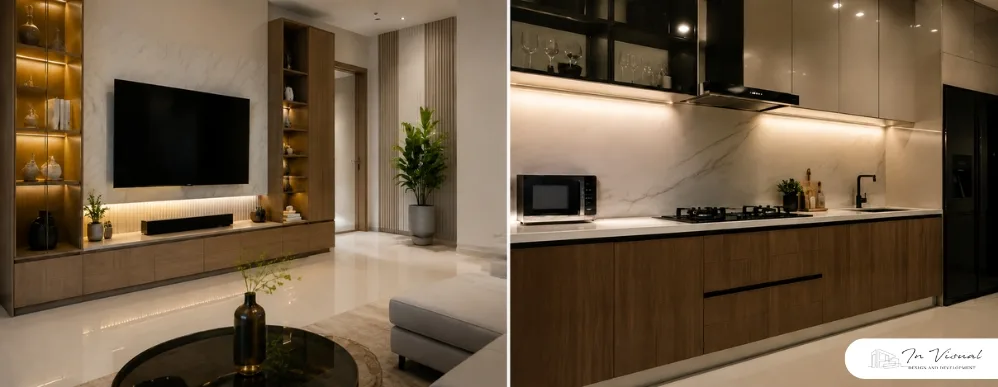
Modular vs Traditional Interior Design
The phrase modular vs traditional interior design often refers to factory-manufactured furniture compared with conventional on-site carpentry.
Traditional interior work usually involves carpenters cutting, assembling, laminating, polishing, and finishing components at the property.
Advantages of traditional or on-site interior work
- Easy on-site adjustments
- Suitable for unusual dimensions
- Greater freedom during execution
- Local labour availability
- Custom detailing
- Flexible material selection
Limitations of traditional interior work
- More dust and noise
- Longer on-site duration
- Greater dependence on carpenter skill
- Possible inconsistency in finishing
- More supervision required
- Material wastage may be higher
Advantages of modular interior work
- Factory consistency
- Faster installation
- Cleaner site
- Standard hardware systems
- Easier project scheduling
Limitations of modular interior work
- Less flexibility after production
- Dependence on accurate initial measurements
- Restrictions in highly irregular spaces
- Potential gaps created by fixed module sizes
- Limited scope for last-minute design changes
Therefore, modular vs traditional interior design is not simply a choice between modern and outdated methods. Both can be effective when selected according to the property and managed professionally.
Which Option Is Better for Different Ahmedabad Properties?
2BHK or 3BHK apartments
A hybrid approach is generally suitable:
- Modular kitchen
- Modular or customized wardrobes
- Custom TV unit
- Custom study areas
- Personalized lighting
- Space-saving furniture
Luxury apartments
Custom interiors are usually more appropriate because they allow better coordination between architecture, furniture, materials, lighting, automation, and premium detailing.
Bungalows and villas
Custom design is typically the stronger choice. Large homes require personalized zoning, furniture proportions, ceiling treatments, lighting plans, storage, and architectural coordination.
Farmhouses
Custom interiors work well because farmhouse layouts, indoor-outdoor connections, natural materials, storage needs, and weekend living requirements are rarely standardized.
Rental homes
Basic modular units can be practical because they offer faster installation, manageable maintenance, and standardized replacement.
Renovation projects
The right choice depends on existing site conditions. Custom work may be necessary when old walls, flooring, services, windows, or structural elements do not match standard modular dimensions.
When Should You Choose Modular Interiors?
Choose modular interior design Ahmedabad services when:
- You need faster project completion
- Your rooms have standard dimensions
- You prefer factory-finished components
- You want simplified installation
- You are comfortable choosing from a catalogue
- Your storage needs are straightforward
- You want clearer package-based pricing
- You may need replaceable components later
When Should You Choose Custom Interiors?
Choose custom interior design Ahmedabad services when:
- You want a unique home
- Your property has irregular dimensions
- You require maximum space utilization
- You have specific storage needs
- You want personalized furniture
- You prefer special materials or finishes
- Your design must coordinate with architecture
- You are planning a premium residence
- You want the interiors to reflect your lifestyle
- You need detailed Vastu integration
- You want greater control over the final appearance
Is a Hybrid Interior Design Approach Better?
For many homeowners, the answer is yes.
A hybrid strategy combines the efficiency of modular manufacturing with the flexibility of customized design.
A typical hybrid project may include:
- Factory-produced modular kitchen cabinets
- Customized kitchen layout
- Modular wardrobe carcasses
- Personalized wardrobe interiors
- Custom living room furniture
- Bespoke TV units
- Customized ceiling and lighting plans
- Made-to-measure study units
- Site-specific wall panelling
- Personalized loose furniture
This approach can deliver:
- Faster execution
- Better finish consistency
- Improved space utilization
- Greater personalization
- Practical budget control
- Easier future maintenance
The best interior solution is not necessarily entirely custom or entirely modular. It is the solution that uses the right construction method for each part of the home.
Questions to Ask Before Finalizing an Interior Designer
Before selecting a company for custom or modular interiors, ask:
- Is the design created specifically for my property?
- Which parts will be modular and which will be custom-made?
- What materials and board grades are included?
- Which hardware brands and specifications are proposed?
- Does the quotation include civil, electrical and plumbing work?
- Are transportation and installation included?
- How will unusual walls, columns and corners be handled?
- Will I receive detailed drawings and 3D views?
- Who will supervise the site?
- What warranties apply to materials and hardware?
- How will design changes affect the cost and timeline?
- Will I receive a detailed material specification and cost breakdown?
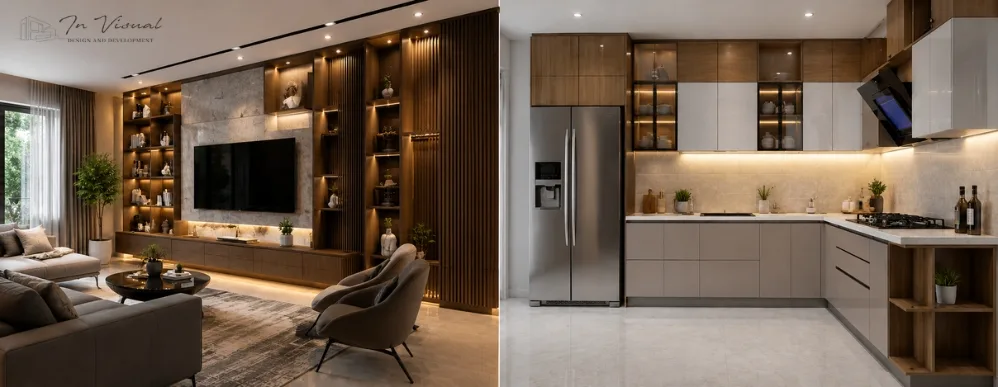
Professional interior firms should provide clarity around planning, material specifications, execution, coordination, payment stages, and project timelines.
Common Mistakes to Avoid
Choosing only by price
The lowest quotation may use different materials, hardware, accessories, or scope. Compare specifications – not only the final amount.
Finalizing before understanding the layout
A beautiful finish cannot correct poor space planning. Approve the functional layout before selecting colours and materials.
Ignoring Ahmedabad’s climate
High-gloss surfaces, excessive open shelving, delicate fabrics, and difficult-to-clean details may increase maintenance in a hot and dusty environment.
Using one method everywhere
A modular kitchen may work perfectly, while a standard modular TV unit may waste space. Select the construction method area by area.
Making late changes
Modular units become difficult or expensive to modify after factory production. Finalize dimensions, appliances, electrical points, plumbing, and finishes beforehand.
Ignoring hardware quality
Hinges, channels, lift-up systems, sliding mechanisms, and drawer accessories affect daily convenience and long-term performance.
FAQs
1. Are custom interiors more expensive than modular interiors?
2. Are modular interiors durable?
3. Which is better for a modular kitchen in Ahmedabad?
4. Can modular interiors be customized?
5. Which option is better for small apartments?
6. Is custom interior design suitable for renovations?
7. How long do custom and modular interiors take?
8. What is the difference between modular and traditional interior design?
9. Can I combine custom and modular interiors?
10. How do I choose an interior designer in Ahmedabad?
Final Verdict: Custom vs Modular Interiors
There is no single winner in the custom vs modular interiors debate.
Choose modular interiors for standardized spaces, faster installation, factory consistency, and straightforward requirements.
Choose custom interiors for complete personalization, superior space utilization, distinctive aesthetics, architectural integration, and lifestyle-specific planning.
For most modern Ahmedabad homes, a customized hybrid interior solution provides the strongest balance. Kitchens, wardrobes, and storage carcasses can benefit from modular production, while furniture, room layouts, lighting, materials, and visual details can be customized.
At InVisual Interior Designer Ahmedabad, every project begins by understanding the client’s lifestyle, space, requirements, and vision. The objective is not to force a property into a fixed design package, but to create an interior that balances comfort, functionality, durability, aesthetics, and individuality.
Whether you are planning an apartment, bungalow, farmhouse, villa, or private residence, the right decision should be based on how you want the space to function for years – not only how quickly it can be installed.
Planning a new home or renovation in Ahmedabad?
Consult InVisual Interior Designer Ahmedabad for a personalized interior solution that combines smart planning, durable materials and thoughtful execution.